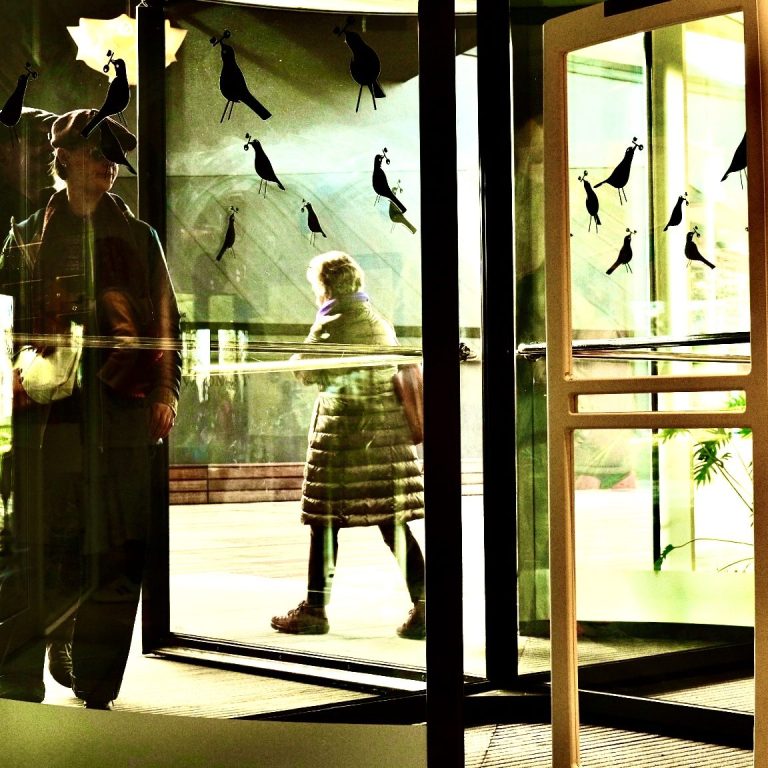
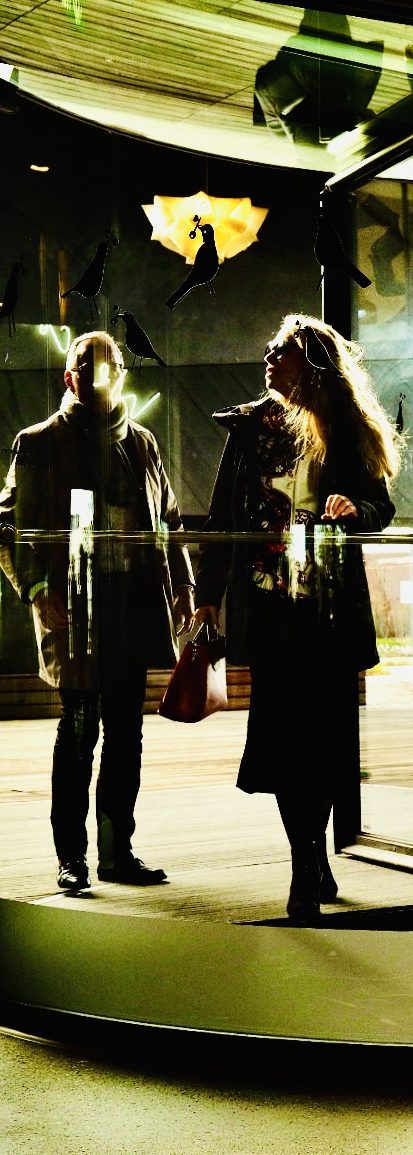
Wie ein Simulacrum vervielfachen sich die Figuren: mehrere Identitäten überlagern sich, überschneiden sich, verschwimmen. Das Ich erscheint als Schichtung, als Vielheit, als widersprüchliches Nebeneinander.
Die Bilder wirken fast wie Chiaroscuro-Szenen der Gegenwart: Licht und Schatten, Ernst und Ironie, Absurdität und Melancholie fallen ineinander.
Doch die Drehtür bewegt sich weiter, kreist endlos, eine einförmige Bewegung ohne Ziel. Von wem wird sie angetrieben? Von uns selbst, von der Gesellschaft, von unsichtbaren Kräften? Sie ist Motor und Metapher zugleich: Die Suche, das Leben bleibt in Bewegung, gerade weil es nie ein endgültiges Ankommen gibt.
Ceci n’est pas une porte tournante
So wird die Drehtür zum Pentimento unserer Zeit: sie zeigt die glatte Oberfläche von Bewegung und Effizienz, während darunter Isolation, Verlorenheit und das Verlangen nach Begegnung sichtbar werden. Und zugleich spiegelt sie das Verhältnis zwischen Mensch und Welt: eine Welt, die sich unaufhörlich dreht, und ein Ich, das sich im gleichen Kreis auf die Suche macht. getrieben, suchend, nie still.
Text von Christian Feichtinger
Mit einem Augenzwinkern verweist der Titel auf René Magritte und zugleich öffnet er die Tür zum Surrealismus.
Die Drehtür wird zum Sinnbild unserer Zeit: ein Ort der Bewegung, aber auch des Stillstands. Man tritt ein, man tritt aus, und doch bleibt man gefangen in einer Endlosschleife.
ITALIANO
Il titolo richiama l’universo di René Magritte e al contempo, apre la porta al Surrealismo.
La porta girevole si configura come il simbolo del nostro tempo: un luogo di continuo movimento, ma anche di stasi. Si entra, si esce, eppure si resta intrappolati in un loop infinito.
Come un simulacro, le figure si moltiplicano: identità multiple si sovrappongono, si intrecciano, si confondono. Il "sé" emerge come stratificazione, molteplicità, un accostamento contraddittorio.
Le immagini sembrano assomigliare a scene di chiaroscuro della contemporaneità: luce e ombra, serietà e ironia, assurdità e malinconia si fondono in un’unica, ambigua sintesi.
Eppure, la porta girevole continua a girare, senza fine, in un movimento uniforme privo di scopo. Chi la muove? Siamo noi stessi, la società, o forze invisibili?
Essa è sia motore che metafora: la ricerca, la vita, restano in movimento proprio perché non esiste mai una vera e propria conclusione.
Così, la porta girevole diventa il pentimento del nostro tempo: essa mostra la superficie liscia del movimento e dell'efficienza, mentre sotto essa si celano l'isolamento, lo smarrimento e il desiderio di incontro.
Al contempo, essa riflette la relazione tra l'uomo e il mondo: un mondo che gira incessantemente e un "io" che si cerca, nel medesimo cerchio. Spinto in una continua ricerca, senza mai fermarsi.
Testo di Christian Feichtinger
FRANCAISE
Le titre fait écho à l’univers de René Magritte et, simultanément, ouvre la porte du Surréalisme.
La porte tournante devient le symbole de notre époque : un espace de mouvement incessant, mais aussi d’immobilité apparente. On entre, on sort, et pourtant on reste pris dans une boucle infinie.
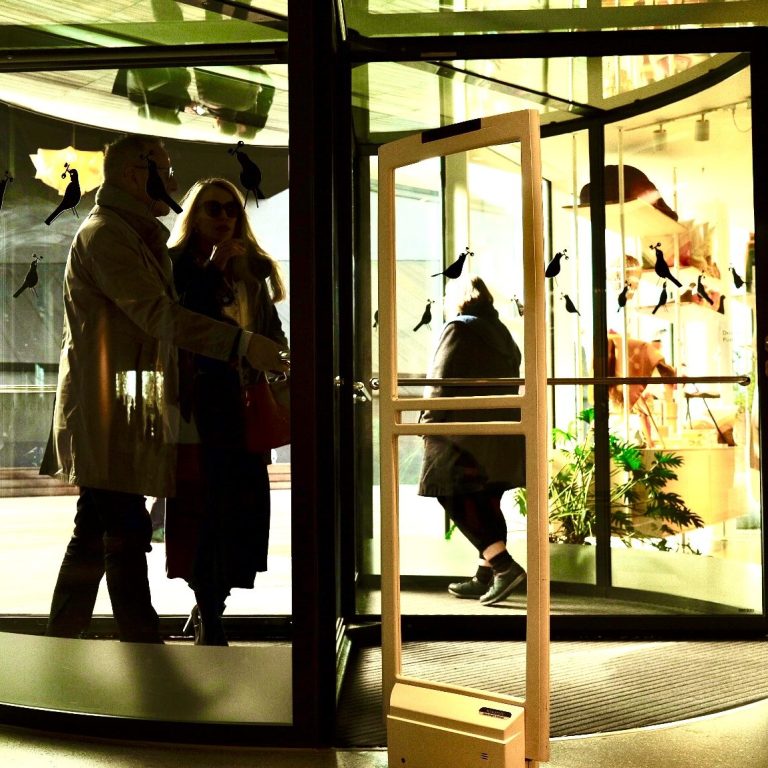
Tel un simulacre, les figures se multiplient : plusieurs identités se superposent, se tissent, se confondent. Le "soi" apparaît comme une stratification, une multiplicité, un assemblage contradictoire.
Les images semblent ressembler à des scènes de clair-obscur de la contemporanéité : lumière et ombre, sérieux et ironie, absurdité et mélancolie fusionnent en une même unité ambiguë. Et pourtant, la porte tournante continue de tourner, inlassable, dans un mouvement uniforme dépourvu de but. Qui en est le moteur ? Nous-mêmes, la société, ou des forces invisibles ? Elle est à la fois moteur et métaphore : la quête, la vie, restent en mouvement précisément parce qu’il n’existe jamais de véritable arrivée.
Ainsi, la porte tournante devient le repentir de notre époque : elle dévoile la surface lisse du mouvement et de l’efficacité, tandis qu’en dessous émergent l’isolement, la perte et ce désir irrésistible de rencontre.
Elle reflète également la relation entre l'homme et le monde : un monde qui tourne sans fin et un "je" qui se cherche, sans jamais s'arrêter, dans le même cercle. Poussé dans une quête continue, sans jamais s’arrêter.
Texte de Christian Feichtinger
The title refers to René Magritte and, at the same time, opens the door to Surrealism.
The revolving door becomes the symbol of our time: a place of movement, yet also of stillness. We enter, we exit, and yet remain trapped in an infinite loop.
Like a simulacrum, figures multiply: multiple identities overlap, intertwine, and blur. The "self" appears as a stratification, a multiplicity, a contradictory assemblage.
The images seem almost like chiaroscuro scenes of contemporaneity: light and shadow, seriousness and irony, absurdity and melancholy merge together.
And yet, the revolving door continues to spin, endlessly, a uniform movement without purpose. Who is making it turn? Ourselves, society, or invisible forces?
It is both engine and metaphor: the search, life itself, remains in motion precisely because there is never any true arrival.
Thus, the revolving door becomes the repentance of our time: it shows the smooth surface of movement and efficiency, while beneath it emerge isolation, loss, and the desire for connection.
At the same time, it reflects the relationship between man and the world: a world that spins endlessly, and a "self" that searches, never stopping, within the same circle.
Driven by an unceasing quest, it never halts.
Texts by Christian Feichtinger
ENGLISH
Ceci n’est pas une porte tournante
Ceci n’est pas une porte tournante
Ceci n’est pas une porte tournante